Automate dependency updates at scale
Give your devs what they need to get proactive with dependency updates.

Challenges
Obvious doesn’t mean easy
Keeping dependencies current is one of the most effective AppSec methods available, since it prevents vulnerabilities from entering the codebase at the outset. It should be a no-brainer, but updating dependencies is a complex task that takes time and often introduces technical debt.

Security risk vs. dev deadlines
There’s a reason devs prioritize developing applications over running maintenance checks—applying updates takes time, especially if an update requires reworking code.
The complexity of context
Especially in a complex dependency tree, it’s difficult to even know what libraries or packages are out of date. Manually looking for updates is time-consuming and unrewarding work.
Merge anxiety
Updates may not always be compatible with existing code, and without confidence that an update won’t break their app, devs hesitate to merge.
Opportunities
Remove the risk. Reap the rewards.
As a critical tool to shrinking technical debt and the application attack surface, dependency management isn’t an individual developer matter. It’s an organizational problem that needs to be solved in a more efficient and secure way.

Full-scale automation
Automated dependency updates streamline and optimize your devs’ entire dependency management process.
Centralized responsibility
Deploying automated tools organization-wide not only shifts responsibility from individual developers, but also ensures consistency across all applications and simplifies the development process.
Merge confidence
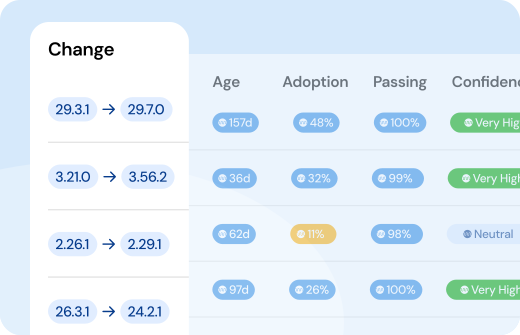
Providing devs with a calculated merge confidence rating for each pull request allows them to immediately submit high-confidence updates and significantly cut their workload.
The solution
Mend Renovate
Reduces risk, improves code quality, and cuts technical debt by automatically ensuring all dependencies are kept up to date.
Discover Mend Renovate

“One of our most indicative KPIs is the amount of time for us to remediate vulnerabilities and also the amount of time developers spend fixing vulnerabilities in our code base, which has reduced significantly. We’re talking about at least 80% reduction in time.”


“When the product you sell is an application you develop, your teams need to be fast, secure and compliant. These three factors often work in opposite directions. Mend provides the opportunity to align these often competing factors, providing Vonage with an advantage in a very competitive marketplace.”


“The biggest value we get out of Mend is the fast feedback loop, which enables our developers to respond rapidly to any vulnerability or license issues. When a vulnerability or a license is disregarded or blocked, and there is a policy violation, they get the feedback directly.”


FAQs
How does Mend Renovate automate dependency updates?
Mend Renovate automatically checks for updates, delivers pull requests to your repo, and preps each PR with the context developers need to merge confidently.
How does Mend Renovate’s merge confidence keep updates from breaking builds?
Every update PR gets a calculated merge confidence score. Merge Confidence shows developers how likely an update is to cause problems based on package age, adoption rate, and test-pass rate across the open source ecosystem. Riskier updates stand out, while high-confidence updates can move faster through workflows you configure.
Will Mend Renovate’s automated updates break my build?
Merge Confidence exists to prevent exactly that. Each PR is scored before you merge, replacing merge anxiety with data.
How does Mend Renovate reduce my vulnerability backlog?
Staying current keeps dependency debt from piling up. Mend Renovate makes updates smaller and continuous, so when security fixes are released, teams have fewer outdated versions to work through. Security updates can be raised as soon as Mend Renovate detects them.
See where updates fit in a broader strategy, read dependency management vs. dependency updates.
How does Mend Renovate help support both developers and AppSec programs?
Mend Renovate turns dependency updates into a consistent, automated workflow: developers get ready-to-review PRs and Merge Confidence in the tools they already use, while security gets a more systematic way to keep dependency risk from accumulating across teams.
Does Mend Renovate only update npm and Maven packages, or does it touch Dockerfiles and CI config too?
It goes well beyond application packages. Mend Renovate updates Docker base images, GitHub Actions workflow versions, Terraform modules and providers, and Helm charts, alongside npm, Yarn, Maven, Gradle, Go modules, NuGet, and Python managers like pip and poetry, more than 50 package-manager formats in total.
Will turning on Mend Renovate flood my team with pull requests?
Not by default. Mend Renovate caps new PRs at 2 per hour and 10 open at once out of the box. You can also group updates, schedule runs for off-hours, or fold everything into weekly batches instead of one PR per dependency bump.
How does Mend Renovate show which updates are still pending?
Through the Dependency Dashboard, a single issue Mend Renovate opens in each repo listing every pending, rate-limited, or errored update in one place. Instead of hunting through individual pull requests, a developer gets one dashboard showing what’s outstanding and why an update hasn’t opened yet.
Does Mend Renovate keep lockfiles current even when no dependency version has changed?
Yes. Mend Renovate’s lockfile maintenance feature deletes and regenerates your lockfile on a schedule, so hashes and transitive dependency records stay current between version bumps, opened as its own pull request.
Can Mend Renovate pull dependencies from a private registry like Artifactory or a private npm feed?
Yes. Mend Renovate supports host rules for private registries, including JFrog Artifactory and private npm feeds, so it authenticates and resolves internal packages the same way it resolves public ones.
Stop managing alerts.
Start reducing risk.
Join the teams reducing remediation effort by 75%.