Automated Software Bill of Materials (SBOM) Management
Generate accurate, continuously updated SBOMs across every application, in every format you need.
Challenges
Software development is dynamic. Manual SBOMs aren’t.
With different teams using different tools, technology, and constantly updated open source software packages, maintaining an accurate SBOM can be incredibly difficult.

Constant change
Identifying every open source dependency and monitoring each for updates overwhelms most security teams.
Manual processes
Tracking a constant stream of changing components and versions manually almost guarantees human error.
The risks of bad automation
While automation is crucial to success, companies face increased risk if it isn’t done right.
Opportunities
Beyond static to effective
Using SBOMs to create software inventories to meet compliance or industry requirements is a great start. However, the possibilities beyond compliance are even more compelling.

Cut the risk of human error
Effective automation that automatically updates open source dependencies and packages across all applications eliminates error-prone manual processes.
Accurate risk assessment
Automated dependency identification delivers up-to-the-minute risk assessments and ensures license compliance.
Prioritize high-risk vulnerabilities
Not all vulnerabilities pose a risk. By knowing whether your code reaches vulnerable functions, you can prioritize remediation based on actual risk.
The solution
Navigate open source with confidence
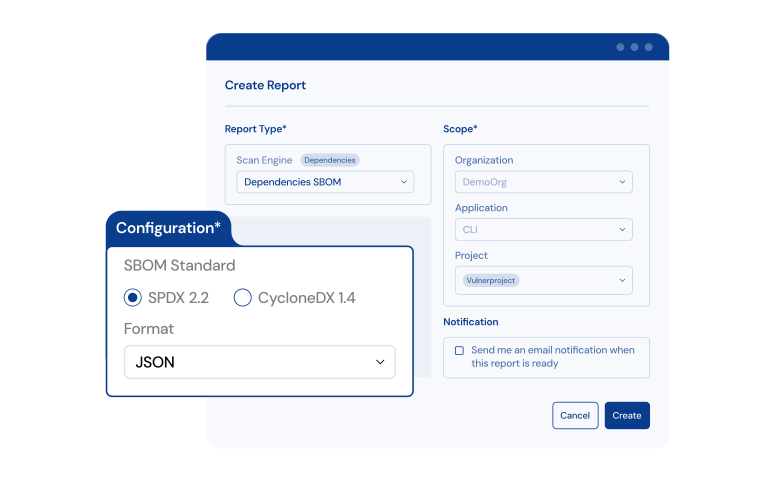
Mend SCA automatically generates accurate, comprehensive SBOMs in both SPDX and CycloneDX formats. It incorporates VEX data and integrates third-party SBOMs — so your software stays secure, compliant, and transparent to every downstream consumer.
Discover Mend SCA

“One of our most indicative KPIs is the amount of time for us to remediate vulnerabilities and also the amount of time developers spend fixing vulnerabilities in our code base, which has reduced significantly. We’re talking about at least 80% reduction in time.”


“When the product you sell is an application you develop, your teams need to be fast, secure and compliant. These three factors often work in opposite directions. Mend provides the opportunity to align these often competing factors, providing Vonage with an advantage in a very competitive marketplace.”


“The biggest value we get out of Mend is the fast feedback loop, which enables our developers to respond rapidly to any vulnerability or license issues. When a vulnerability or a license is disregarded or blocked, and there is a policy violation, they get the feedback directly.”


FAQs
How does Mend.io continuously update an SBOM?
Mend SCA automatically builds and updates an inventory of the open source libraries, packages, and other third-party components identified during scans. Teams can generate SBOM reports in SPDX and CycloneDX formats, incorporate VEX data, import third-party SBOMs, and keep everything continuously updated across every application.
How is Mend.io’s continuous inventory different from a static SBOM export?
A static export is outdated by the next commit. Mend SCA regenerates the inventory as dependencies change, so security reviews and audits always run against your actual current risk.
New to SBOMs? Start with what an SBOM is and its key benefits.
How does Mend.io incorporate VEX into SBOMs?
Mend SCA adds VEX exploitability context to each component automatically, so consumers of your SBOM see which vulnerabilities have known exploits.
Can Mend.io SBOMs satisfy EO 14028 and EU Cyber Resilience Act requirements?
Yes. Mend.io SBOMs are machine-readable (SPDX/CycloneDX), formatted for VEX and CISA submission, and continuously updated, meeting the transparency requirements both regulations impose.
How does Mend.io prioritize risks found in an SBOM?
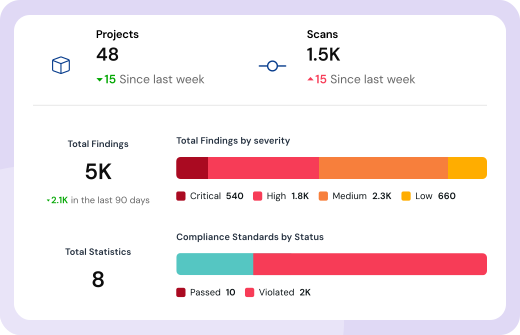
Mend SCA enriches the component inventory with vulnerability severity, reachability, exploitability signals, dependency paths, remediation guidance, and malicious-package status. Reachability analysis helps identify whether application code can reach a vulnerable component in supported environments, while additional risk factors help teams focus on vulnerabilities with stronger evidence of real-world risk.
Stop managing alerts.
Start reducing risk.
Join the teams reducing remediation effort by 75%.